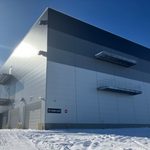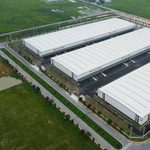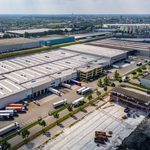
Amid changing economic conditions and shifting supply chains, Mapletree continues to execute its business strategy with discipline and prudence by growing its global logistics platform through an accelerated development strategy. As the Group’s largest asset class with S$32.4 billion in assets under management (AUM), logistics remains its key growth enabler.
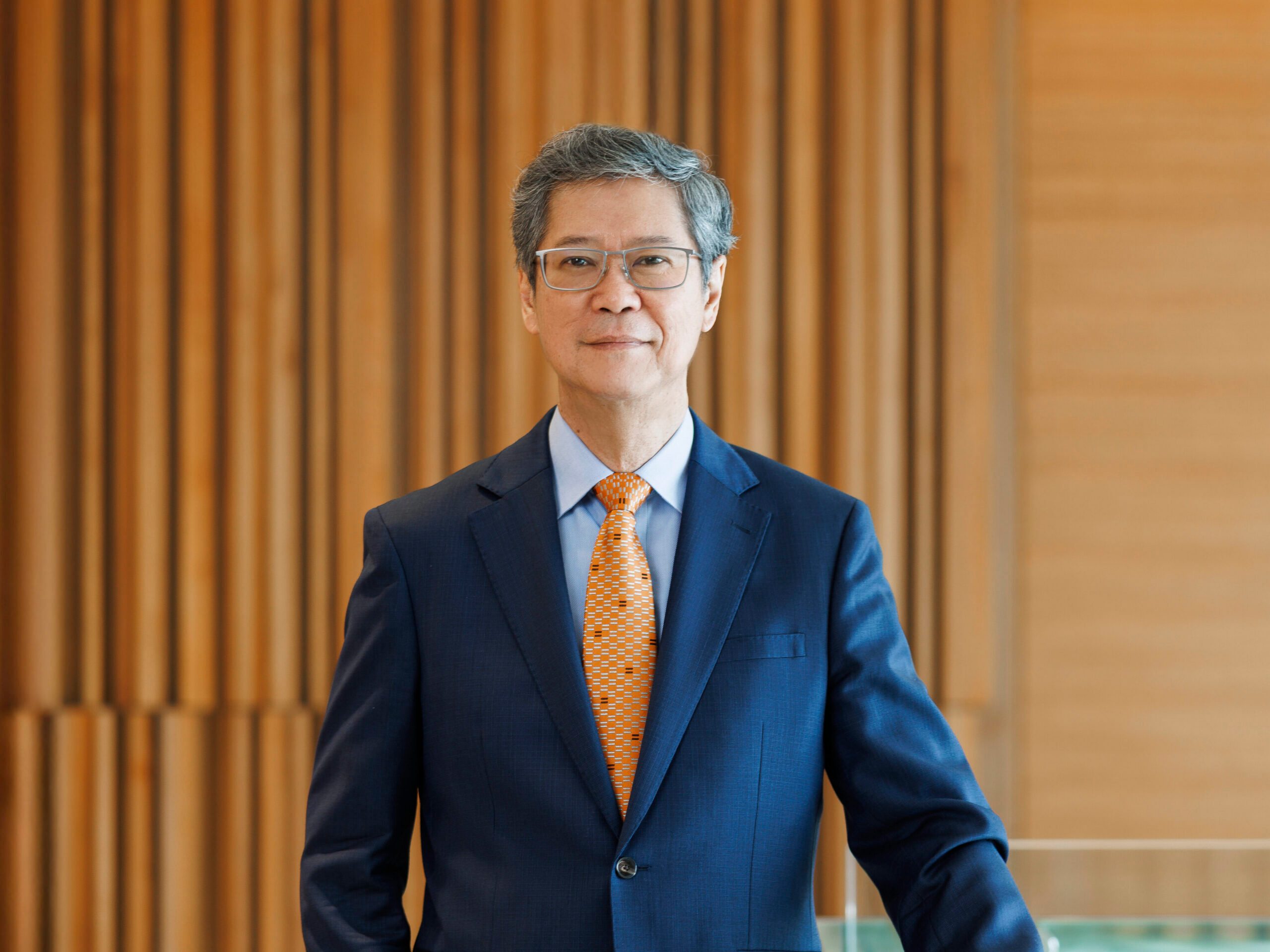
Here’s a closer look at how it is taking shape, in an extract from Group Chief Executive Officer Mr Hiew Yoon Khong’s message in Annual Report 2025/2026.
1. STEADY PERFORMANCE IN A VOLATILE WORLD
Renewed geopolitical tensions, including the United States tariff shock in 2025 and the escalating Middle East conflict in 2026, introduced fresh inflationary and growth concerns in Financial Year 2025/2026 (FY25/26). Despite this, Mapletree delivered stable operating performance, underpinned by diversified income streams, proactive capital management and nimble execution across its core sectors and markets. The Group recorded revenue of ~S$2.2 billion¹ and S$285.6 million in Profit After Tax and Minority Interests (PATMI)², a 25.7% year-on-year increase from S$227.2 million in FY24/25, mainly due to lower asset revaluation losses.
Recurring PATMI increased from S$606.6 million³ in FY24/25 to S$622.8 million in FY25/26 on lower net finance costs and resilient operations. As at 31 March 2026, Mapletree has over 880 assets and S$76.2 billion in AUM across 13 markets globally.
2. BETTER RISK-REWARD METRICS THROUGH DEVELOPMENT
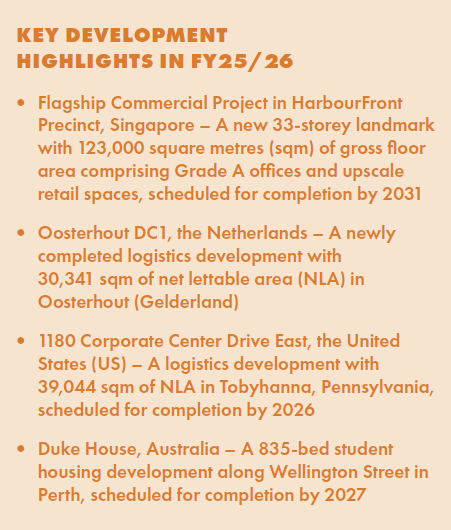
Development properties offer better risk-reward metrics than acquiring investment properties, particularly in today’s high cost-of-capital environment. It also sets Mapletree apart from players that are purely capital managers. In FY25/26, the Group completed 13 development projects, 10 of which were logistics. Contracts were also awarded for 15 new projects, of which 12 were logistics.
3. DEVELOPMENT, NOT JUST ACQUISITION
As at 31 March 2026, Mapletree’s projects under development4 stood at S$5.4 billion, with S$2.6 billion of that in logistics alone. As the Group’s largest asset class at ~43% (S$32.4 billion) of AUM, logistics remains Mapletree’s key growth enabler. New developments were
broken ground in Japan and Vietnam, land sites acquired for new logistics facilities in the US, and a build-to-suit facility in Poland. In Malaysia, a newly acquired Shah Alam site will
offer 321,000 sqm of NLA, to be injected into Mapletree Emerging Growth Asia Logistics Private Trust (MEGA). The Group also delivered six new logistics parks in China totalling approximately 600,000 sqm of NLA in FY25/26.
4. ADVANCING EMERGING ASIA LOGISTICS DEVELOPMENT STRATEGY
Mapletree has secured over US$500 million in equity commitments for the first close of its Emerging Asia logistics development strategy. This comprises US$250 million in commitments secured during the first close of MEGA, along with more than US$250 million raised via a joint venture and direct co-investments into selected development projects in Malaysia.
The investors across the strategy include, among others, sovereign wealth funds, a pension fund and a national investment company. MEGA seeks to raise an additional US$200 million in capital commitments for the second close targeted by early next year.
Altogether, MEGA, the joint venture and the co-investments are expected to comprise a portfolio of assets with total investment value of US$2.1 billion across its target markets
when fully deployed.
5. STRONG OCCUPANCY ACROSS THE PORTFOLIO
Occupancy levels stayed healthy across Mapletree’s diversified portfolio. In Singapore, Mapletree Pan Asia Commercial Trust’s (MPACT)’s flagship Mapletree Business City secured renewals with three of its top 10 tenants and closed FY25/26 at 96.4% committed occupancy, while mTower and Bank of America HarbourFront achieved 95.5%. In India, Global Technology Park and Global Infocity Park ended the year at approximately 92% occupancy. Mapletree Logistics Trust (MLT) maintained 96.9% portfolio occupancy across 175 logistics properties in nine Asia Pacific markets, while committed occupancy at Mapletree China Logistics Investment Private Fund (MCLIP) in China climbed to 92%, up from 80% the prior year. In Australia, Mapletree Logistics Park – Crestmead Stage 3 achieved full occupancy as at 31 March 2026.
6. CAPITAL IS BEING RECYCLED TO FUND THE NEXT PHASE
Mapletree US & EU Logistics Private Trust (MUSEL) has already divested about US$1.5 billion of logistics assets in the US since June 2025, delivering returns in line with its 12% internal rate of return target. Closer to home, Mapletree Logistics Park – Crestmead Stage 2 was divested above valuation, while MLT divested six assets totalling S$99 million. Across the Group, a portion of the S$772 million total net proceeds recorded from strategic divestments was redeployed into acquisitions of higher-yielding properties and developments with higher returns.
Mapletree’s accelerated development strategy is not just about scale. It is about staying disciplined while scaling and building strength through strategy. With MEGA in the pipeline
and projects advancing across Asia, Europe and the US, the Group’s logistics platform looks set to remain its primary growth engine as Mapletree celebrates 25 years.
¹ Revenue is adjusted to exclude incentive fee income, residential revenue and revenue from investments that are not deemed to be the core business activities for the Group.
² PATMI denotes net profit after tax and non-controlling interests attributable to Perpetual Securities Holders and Equity Holder of the Company.
³ Restated figure for FY24/25. With effect from FY25/26, contributions for certain investments that are not deemed to be the core business activities for the Group are excluded from Recurring PATMI.
4 Included development projects held on MIPL’s balance sheet, private funds and residential properties.